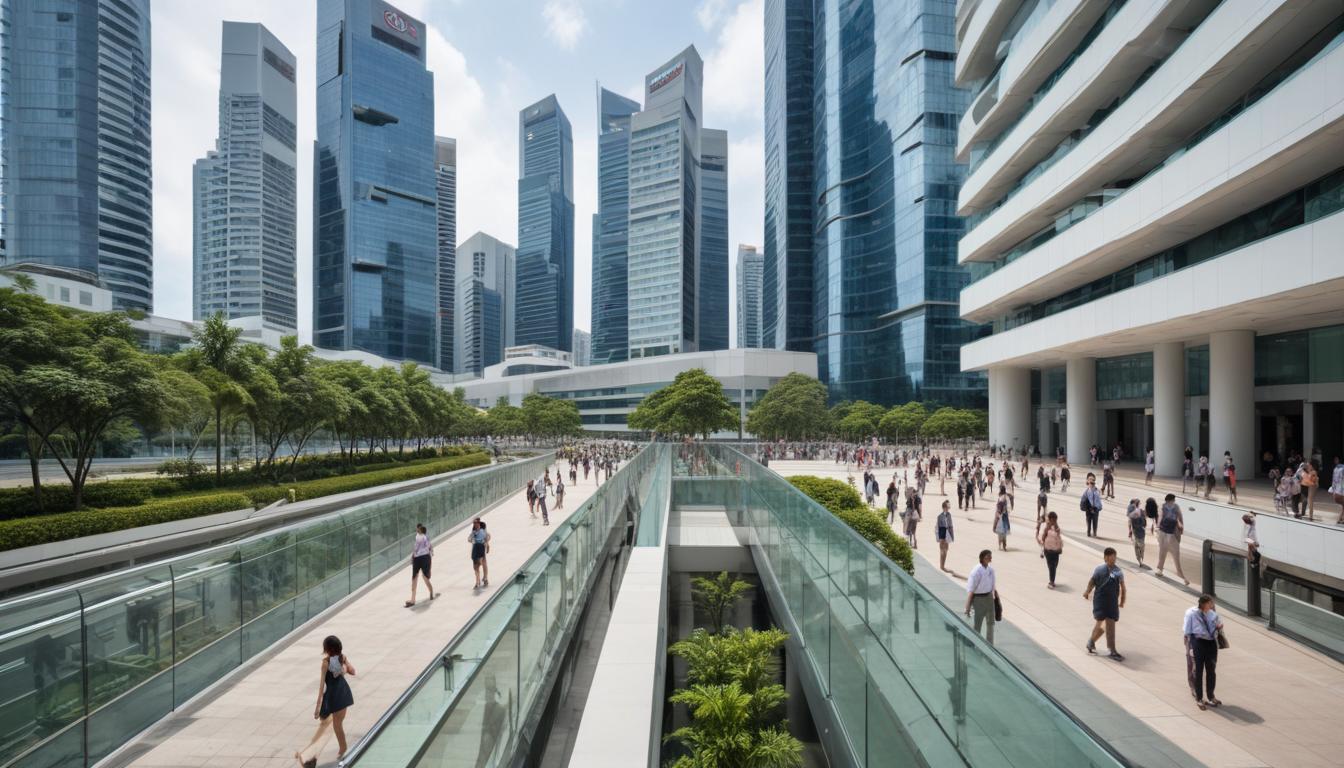
Singapore's startup ecosystem is experiencing a decisive shift. Where once founders gravitated toward a scattered network of co-working spaces and incubators, a coordinated push to create dedicated innovation districts is reshaping the landscape—and early movers are already reaping the rewards.
The most visible transformation is unfolding in the one-north precinct, where commercial rents have climbed 12-15 per cent year-on-year as tech companies and venture-backed startups relocate from Boat Quay and Tanjong Pagar. Deep tech startups focused on semiconductors, quantum computing, and sustainable energy are clustering here, drawn by proximity to research institutions and government-backed funding schemes that have doubled since 2024. Industry observers point to firms securing Series B and C rounds at valuations that would have seemed unlikely just three years ago—some now exceeding $50 million on the back of regional expansion into Malaysia and Vietnam.
The Economic Development Board's push to anchor more Fortune 500 corporate venture arms in Singapore has created a secondary opportunity: established players hunting acquisition targets and partnership deals. Several mid-stage startups in fintech and logistics have benefited from strategic corporate investment, with valuations reflecting premium multiples. A shipping-tech startup operating from Ayer Rajah Crescent recently closed a $15 million Series B led by a Japanese conglomerate with Singapore operations.
Real estate tells another story. Landlords in Blk 71 Ayer Rajah and the Alexandra area—historically affordable for bootstrapped founders—are repricing space upward as demand from larger accelerator programmes and corporate innovation labs intensifies. Monthly rents for 2,000 sq ft office suites have jumped from $4,000-$6,000 to $7,000-$9,000 within 18 months. Smaller teams are being pushed toward the emerging satellite hubs in the Jurong Innovation District, where government incentives are more generous but visibility among investors remains lower.
The winners so far include property developers with early stakes in mixed-use innovation zones, venture capital firms with dry powder allocated specifically to deep tech, and a cohort of founders nimble enough to pivot toward enterprise clients—where deal sizes and margins are expanding faster than consumer-facing models. Government support for sustainability-focused startups has also created a distinct advantage for teams addressing energy transition and circular economy challenges.
However, concerns are mounting about a two-tier ecosystem emerging. Well-connected founders with access to corporate networks and institutional capital are thriving, while bootstrapped and overlooked founders report increasingly intense competition for limited grant funding and angel capital. The next 18 months will reveal whether Singapore's innovation infrastructure investment is genuinely inclusive—or simply amplifying existing advantages.
This article was compiled by AI from the sources linked above and screened before publishing. See our editorial standards.